
How Klemma works
- Describe. For example: "Direct-on-line starter for an 11 kW, 400 V three-phase motor with an emergency stop and a 24 V DC control circuit." Or sketch the system on the draft page as text blocks and lines, or upload a drawing, a PDF or a photo of your idea.
- Proposal. The agent uses typed tools (add a device, connect terminals, set a parameter) to build a proposed change. It does not draw pixels and it does not do arithmetic.
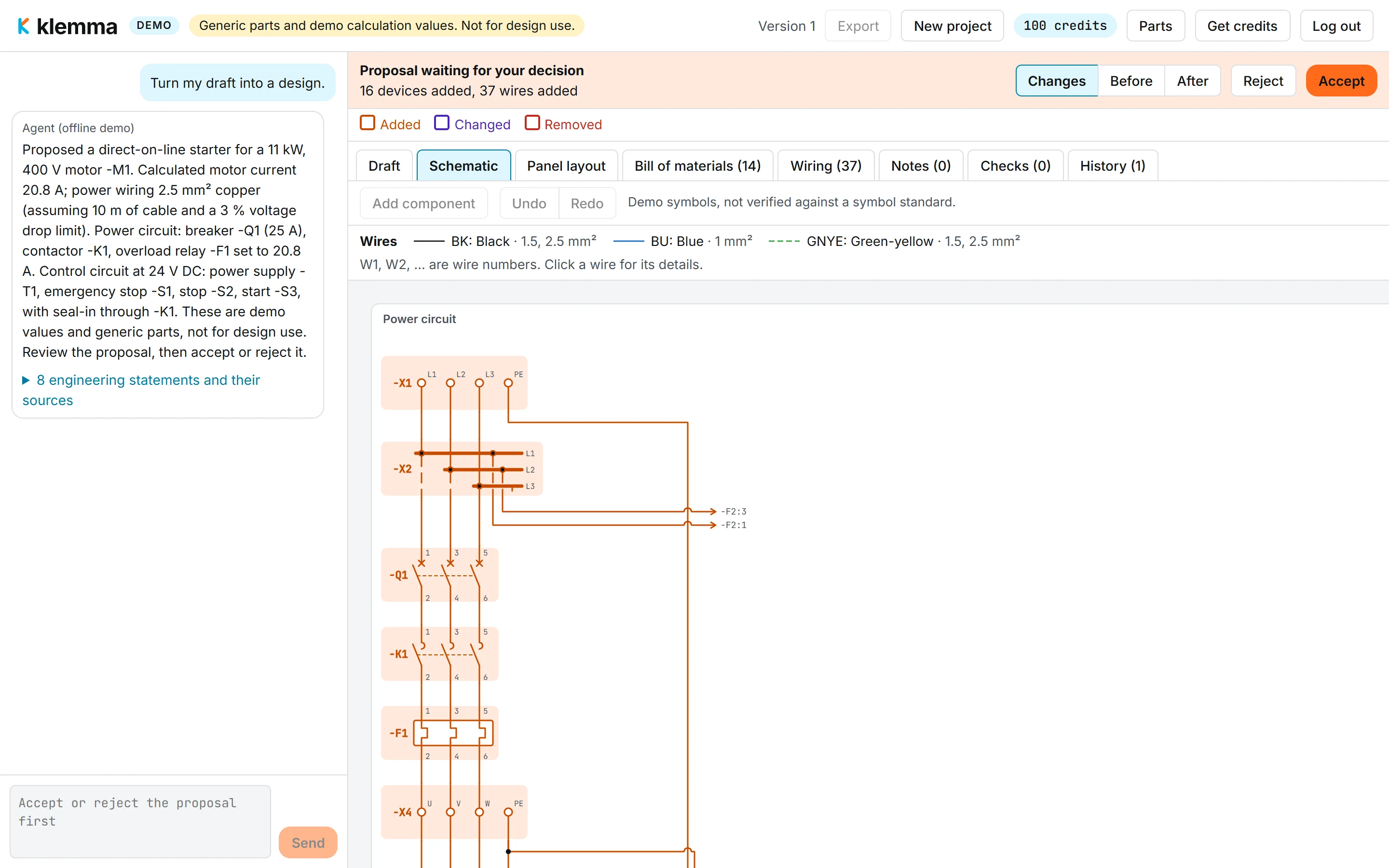
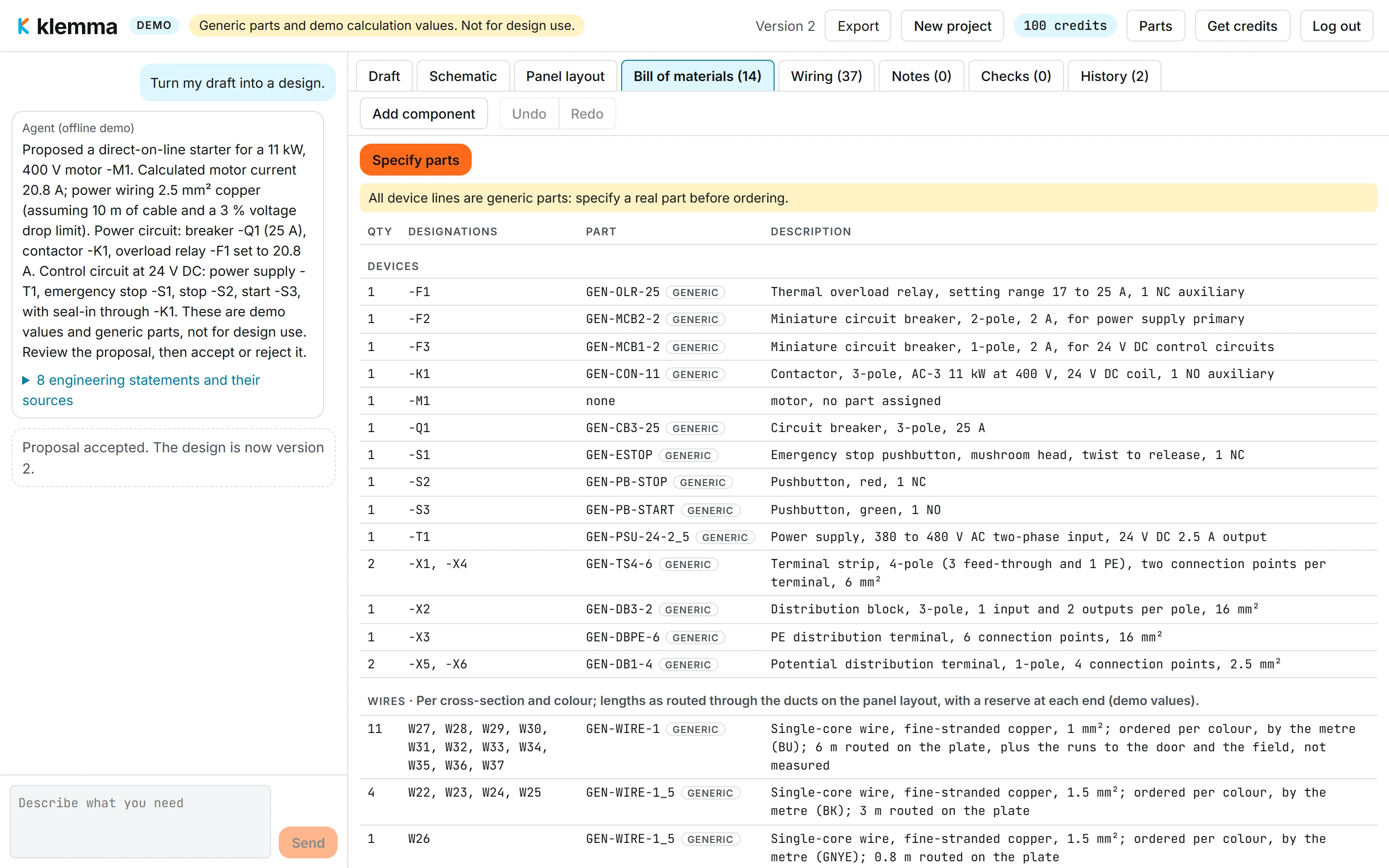
- Review. You see the schematic, the panel layout, the bill of materials and the pin-to-pin wiring table before and after, with warnings from basic rule checks Beta.
- Accept or reject. Accepted changes are appended to an event log. Nothing is applied silently, and any earlier version can be restored.
- Work on it yourself. The schematic and bill of materials are not read-only. Add a component from the parts library, draw a wire by dragging from one terminal to another, move or delete it, swap a part or edit a value. Or pin a note on a device or a wire to tell the agent what you want changed.
- The agent reviews your changes. Your edits go through the same checks as the agent's. Ask the agent to review a change and it looks at what the change affects, such as a cable that is now undersized or a terminal left unconnected, and proposes follow-up changes for you to accept or reject.
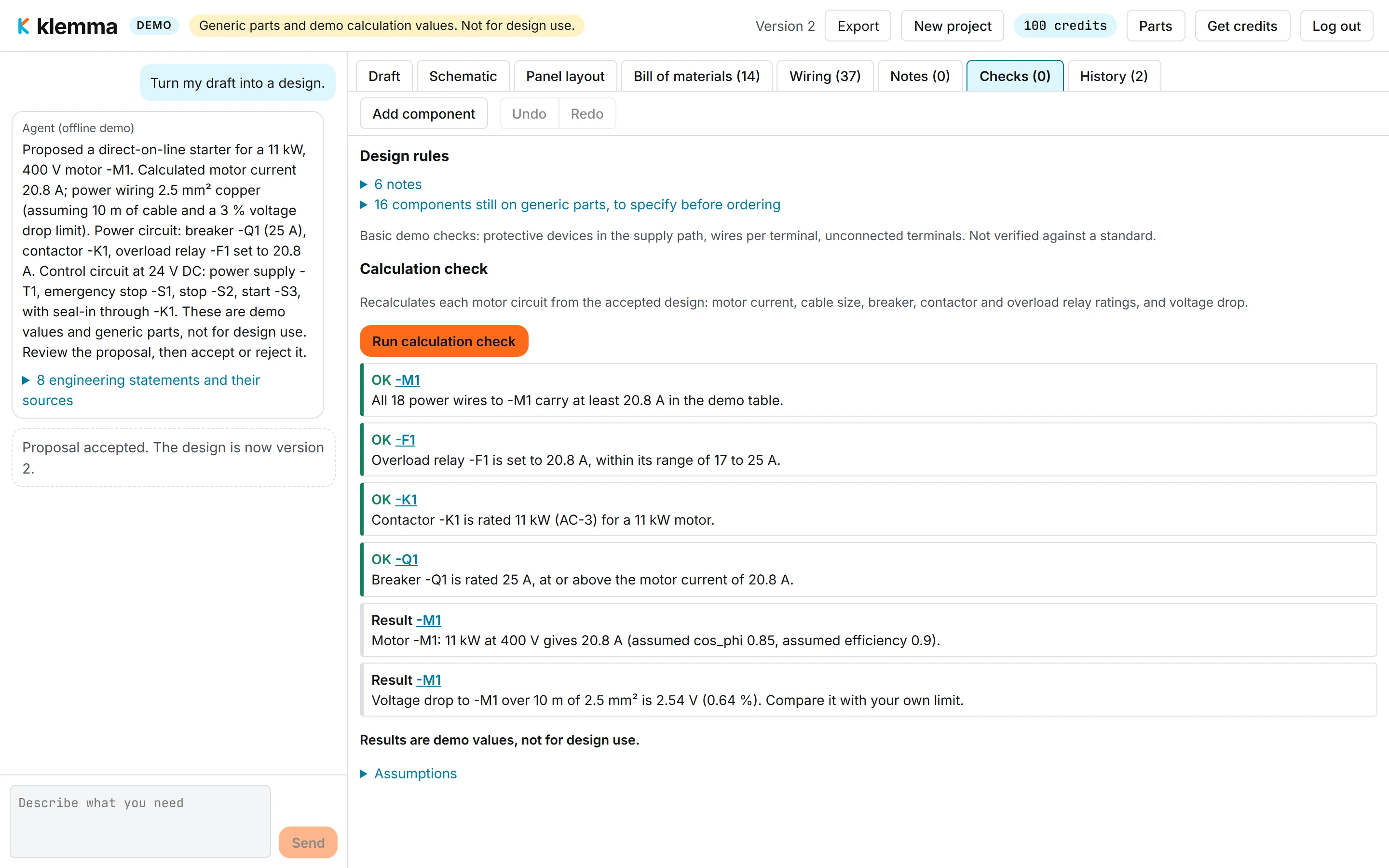
- Calculations Beta. Press Run calculation check to check the design as it stands: cable cross-sections, protective device sizing and voltage drop. The numbers come from deterministic functions, never from the language model, and each result is labelled with its source or "not verified". Checks and calculations are in beta: they help you find problems, and you review every result yourself.
- Production files. Bill of materials (devices, wires with their routed lengths, wire ends, ducts and rails) and pin-to-pin wiring table as CSV; the schematic and the panel layout to scale as SVG and PDF.
Where Klemma goes from here is on the roadmap.
It works both ways
Agent proposes, you review
Describe the requirement. The agent builds a proposal, and you inspect the diff before anything changes.
You edit, agent reviews
Change the design yourself, then ask the agent to review it. It checks what your change affects and proposes the follow-ups.
You leave notes, agent acts
Attach a note to any device or wire. The agent picks the notes up and answers with a proposal.
The demo uses generic parts, placeholders with illustrative ratings, and demo calculation values that are not for design use.